Featured in RFID Journal | By Jessie Hazelrigg, Marketing Director, Wiliot
- Potential use cases for ambient IoT are revolutionary, but the earliest wins may be more utilitarian.
The ambient Internet of Things (IoT)—technology that enables trillions of products to connect to the cloud and communicate their presence and condition—is truly revolutionary. It answers the question, “What if products could talk?”
Indeed, ambient IoT can finally and cost-effectively help realize the promise of a so-called smart refrigerator, which knows what’s inside and “informs” homeowners which groceries need replenishing — or just orders the groceries for them. Smart medication, that “reminds” your elderly parent or caretaker when their prescription hasn’t been taken. A lost passport that “shows” it’s owner where it was left behind.
In all these cases, ambient IoT is a posterchild for innovation — a technological advance that fundamentally changes the way businesses operate, and consumers consume.
But innovation is never without complexity. It presents clear challenges: How do companies begin to innovate? How big should they go? How quickly should they scale?
Navigating these challenges can mean the difference between success and failure.
A Revolution, or an Evolution?
Wiliot, as an innovator itself, has worked with hundreds of businesses to pilot, implement, or scale ambient IoT deployments. Along the way, the company has learned that sometimes the best way to start a revolution is to evolve more modestly, respecting the realities of today while innovating for tomorrow.
Wiliot’s ambient IoT platform is composed of a virtually unlimited number of inexpensive, stamp-sized, self-powered compute devices called IoT Pixels. They are affixed to products, packaging, containers, crates, pallets, and more. These IoT Pixels communicate data to the cloud through Bluetooth—automatically and without human intervention—where businesses can analyze information like location, temperature, humidity, and carbon footprint.
What’s transformative is the minimal infrastructure required. IoT Pixels harvest energy from sources that surround us: smart phones, wireless access points, standards-based gateways. This is what makes them “ambient,” as compute power, connectivity, and intelligence are everywhere, creating a fabric that links the physical world to the digital.
It’s innovative stuff, but innovation can be unnerving. And some risk-averse companies (understandably) may shy away from unnerving.
But with ambient IoT, there’s a way to innovate with minimal risk. The best way to get started is by identifying the pain points of today, the low-hanging fruit — less sexy, more practical innovation that yields an immediate benefit.
Focus on Process, As Well As Products
Innovative technology like ambient IoT often spurs businesses to envision splashy new products, services, and revenue opportunities. Indeed, with visibility all the way to the consumer, ambient IoT can support truly disruptive business models, like automated subscription services for everything from groceries to household supplies.
But many early successes with ambient IoT come from more practical use cases, such as eliminating cost in supply chain processes and other operations. One enterprise, with a large footprint, simply needed a way of not losing all the reusable shipping containers it owned. When the cost of replacing or repositioning containers was eliminated through ubiquitous ambient IoT tracking, the enterprise could show positive ROI. Saving money was as good as generating new money, and innovating an existing process proved a long-term business benefit.
What are some other low-hanging fruits?
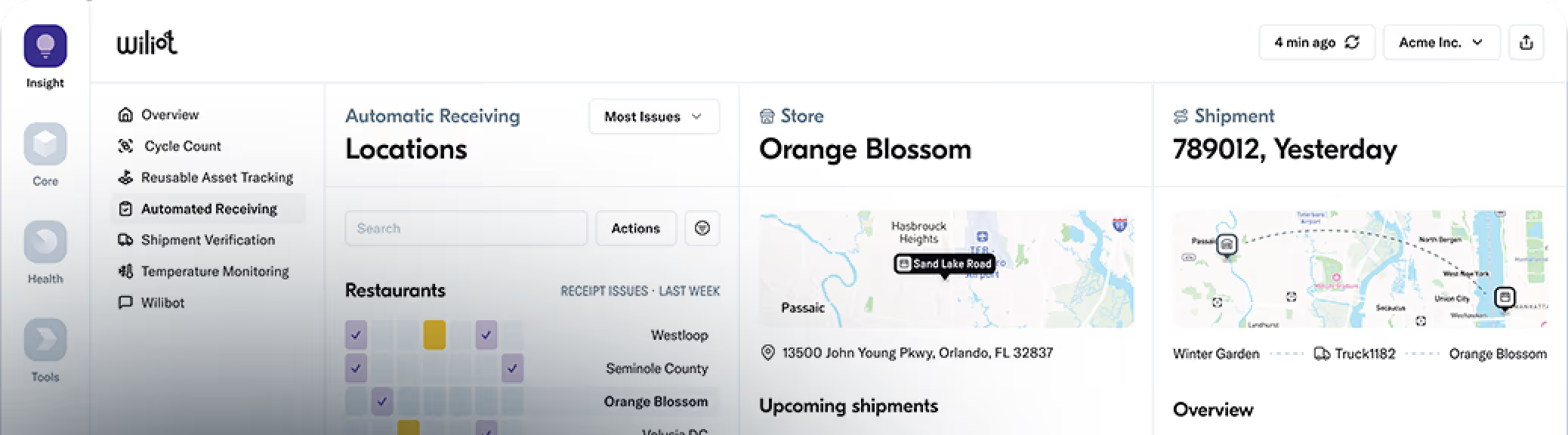
- Innovations in shipping and receiving. Currently, ambient IoT is being used by several large retailers to address pain points in shipping and receiving, especially when it comes to detecting sorting errors. One retailer uses ambient IoT to ensure large or high-value shipments get loaded onto the right trucks; another to detect whether pallets of goods get unloaded at the right stores. A third employs the sensing capabilities of ambient IoT to monitor the temperature of sensitive receivables to reduce waste or lost sales.
- Visibility into asset tracking. For some companies, knowing where their most numerous assets are located saves money and improves operational efficiency. Whether they’re rolling transport carts, pallets, or reusable crates, detecting their location has numerous benefits. For one, far fewer assets get lost and require replacement. For another, companies can “see” these assets as they’re loaded into trucks and begin to calculate optimal utilization rates. One shipper is using ambient IoT tracking to ensure trucks don’t leave a shipping dock half full, thereby wasting fuel.
- Streamlining internal operations. Still others have found ambient IoT critical in understanding better how their warehouses or distribution centers operate. One company is using it to detect the proper location of food pallets. For example, if the food should be refrigerated, is it? And is it in the proper refrigerated cooler when workers go to retrieve it? Another uses ambient IoT for the critical-yet-decidedly-unsexy task of making sure delivery assets are physically located where they need to be in a DC so that there is never a delay in moving goods to their next location.
In all these cases, early adopters of ambient IoT have made the strategic decision to target existing processes, build a foundation of experience and results, then use that as a springboard into fresh innovation.
The Innovation Under Our Noses
Yes, there will always be companies ready to push the revolutionary potential of ambient IoT—effectively enabling products to talk and starting new, disruptive conversations. But as utilitarian, evolutionary use cases show, ambient IoT has plenty to offer the more risk averse.
In fact, it’s hard to over-invest in or over-engineer ambient IoT solutions because so much of the infrastructure already exists. So although it does require some investment, ambient IoT is really a tech innovation right under our noses. Which is why standards bodies for other, long-successful technologies—Bluetooth, Wi-Fi, 5G —are working to include it in their solutions.
Ultimately, the best way to get started with ambient IoT is to find a process or pain point that needs fixing and just fix it. This allows the data to be integrated quickly and lays the foundation. There will definitely be an opportunity to reimagine business through ubiquitous visibility, but don’t lose sight of less flashy wins. Which can be just as innovative.