








Automated supply chain visibility for QSR operators — protecting food quality, reducing waste, and eliminating costly errors at scale
Quick service restaurant supply chains are among the most demanding in the food industry. Thousands of locations, multiple daily deliveries, perishable ingredients with tight shelf-life windows, strict food safety requirements, and lean staffing models create a complex operational environment where small errors carry outsized consequences. A temperature excursion during transit compromises ingredient quality and food safety. A mis-shipment leaves a restaurant short of critical product during a peak service window. An inventory count that cannot be trusted leads to over-ordering, waste, and unnecessary cost.
Addressing these challenges manually — through scanning, counting, and logging — is neither reliable nor scalable at the size and pace of QSR operations. Wiliot's Physical AI platform provides QSR operators with automated, real-time supply chain visibility across every handoff, from supplier to DC to restaurant — using battery-free IoT Pixels that require no labor, no scanning, and no workflow changes to deliver continuous, actionable data.


A real-time view of every ingredient from supplier to restaurant — automatically
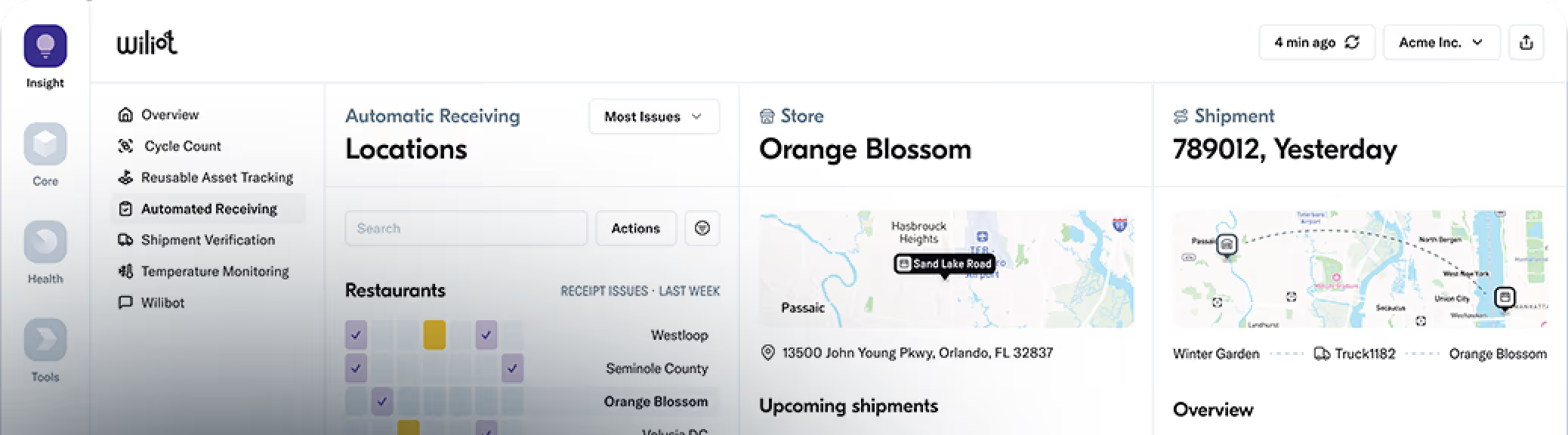
QSR supply chains span thousands of supplier relationships, dozens of distribution centers, and thousands of restaurant locations — all moving perishable product on tight schedules. Wiliot provides real-time tracking of ingredient movement at every stage, automatically identifying delays, deviations, and potential quality issues before they reach the restaurant.
This proactive visibility replaces reactive problem-solving. Instead of discovering a missed delivery or a compromised shipment when a restaurant is already short on product, operators receive alerts the moment an issue is detected — when corrective action is still possible. The result is a more reliable supply chain, fewer service disruptions, and consistent food quality at every location.
Ensure every order reaches the right restaurant — before the truck leaves the dock
When the wrong product is shipped to the wrong restaurant, the consequences multiply quickly. The receiving location loses revenue and customer trust when it runs short on key ingredients. The location that receives an unwanted delivery incurs labor and waste costs processing product it did not order. The distribution operator absorbs the cost of recovery — re-picking, re-routing, and resolving disputes — while the original shipment goes uncompensated.
Wiliot prevents these errors before they occur. Battery-free IoT Pixels on pallets are continuously monitored at dock doors, and the Physical AI platform identifies incorrect or incomplete loads within minutes — generating real-time alerts that enable corrections before trucks depart. Automated bills of lading are generated for every verified load, eliminating manual documentation and providing an objective record of what was shipped, when, and where.
Case-level cold chain protection — from DC to restaurant delivery
Food safety in QSR operations depends on maintaining strict temperature conditions across every stage of the supply chain — from the DC cold room, through the refrigerated trailer, to the restaurant's receiving dock. Zone-level temperature monitoring cannot guarantee product-level compliance: a trailer can register a compliant temperature while individual cases experience excursions during loading or transit.
Wiliot monitors at the case level. Battery-free IoT Pixels track temperature continuously and send real-time alerts the moment a specific product deviates from safe thresholds — enabling immediate intervention before damage, spoilage, or food safety risk occurs. Complete temperature history is recorded automatically per SKU and lot, creating audit-ready documentation for FSMA, HACCP, and brand food safety standards — with no manual logging required.
Continuous, automated inventory visibility inside every restaurant and DC
Manual inventory counts in QSR environments are time-consuming, error-prone, and provide only a snapshot of a constantly changing reality. Wiliot replaces manual counting with continuous, automated inventory visibility across every defined storage area — walk-in coolers, freezers, dry storage, and receiving areas.
Inventory updates automatically as products move, eliminating the lag between physical reality and system records. FIFO management is transformed into FEFO — First Expired, First Out — with automated alerts that ensure the oldest or soonest-to-expire product rotates first. The result is less waste, fewer over-orders, and better ingredient availability during peak service hours — without adding any counting labor.

Battery-free IoT Pixels require no scanning, no manual logging, and no workflow changes — visibility is continuous and automatic.

Unlike zone-level systems, Wiliot tracks temperature at the individual case level, catching excursions that trailer sensors miss entirely.

The same platform that monitors a single DC works across thousands of restaurant locations — without re-architecture or incremental complexity.

Real-time dock monitoring catches load errors before trucks leave, eliminating the downstream cost of wrong deliveries across a distributed restaurant network.

Automated temperature records and traceability documentation support FSMA, HACCP, and brand food safety audit requirements — generated continuously, without manual effort.

Cloud-to-cloud (C2C) data transfer integrates with existing ERP, WMS, and food safety platforms. SDK and open APIs available for custom alert workflows.