Beyond RFID: Why Ambient IoT is the Next Evolution in Asset Tracking
September 4, 2025
By Amir Khoshniyati
Organizations have spent years perfecting radio frequency identification (RFID) implementations. RFID revolutionized asset tracking by eliminating manual processes in certain use cases and enabling rapid inventory management. Yet every RFID success story has its own limitations — gaps in visibility, dependence on human processes, challenges with scalability due to steep infrastructure costs, condition monitoring limitations, and lack of environmental awareness.
While these systems are working well, "working well" might not be enough anymore in today's hyper-competitive market. So, what's next?
The RFID Foundation: Success with Boundaries
RFID transformed asset tracking by enabling organizations to process millions of items in seconds rather than minutes and hours, dramatically improving operational efficiency and inventory accuracy. Unlike barcodes and QR codes that require perfect positioning and lighting with direct line of sight, RFID tags can be embedded behind labels and read without precise alignment. This eliminated the manual scanning errors that plagued earlier technologies.
This success created massive value and established RFID as the backbone of modern supply chain operations. Overhead readers on conveyor belts, automated terminals in warehouses — RFID excels in structured environments where items move through predictable paths.
However, RFID has notable blind spots that become more apparent as market demands evolve:
Visibility Gaps: Between scanning moments, assets remain invisible to the system. Items can get misplaced, damaged, or stolen without detection until the next scan.
Human Dependency: Despite automation capabilities, someone still needs to scan items at the right times and places. Picture a warehouse manager tasked with twice-daily inventory scans across three levels of storage — if they're distracted or simply forget to scan one section, that's manual error the system can't prevent.
Limited Range: Even in optimal conditions, RFID typically achieves 15-20 meter read ranges, requiring closer proximity for reliable scanning.
Single-Purpose Chips: Standard RFID uses one chip with one capability. If you need temperature monitoring for cold chain compliance, you must switch to different chips and recalibrate your entire reader infrastructure.
Infrastructure Costs: Dependable handheld readers and overhead installations require significant capital investment, creating barriers to broader deployment.
Traditional RFID's most significant limitation is environmental blindness. The technology identifies what assets exist and when they were last scanned, but provides no information about the conditions those assets experienced. For temperature-sensitive pharmaceuticals, food products, or any quality-controlled processes, this creates critical gaps that the market increasingly demands to fill.
The Evolution: Ambient IoT as the Next Chapter
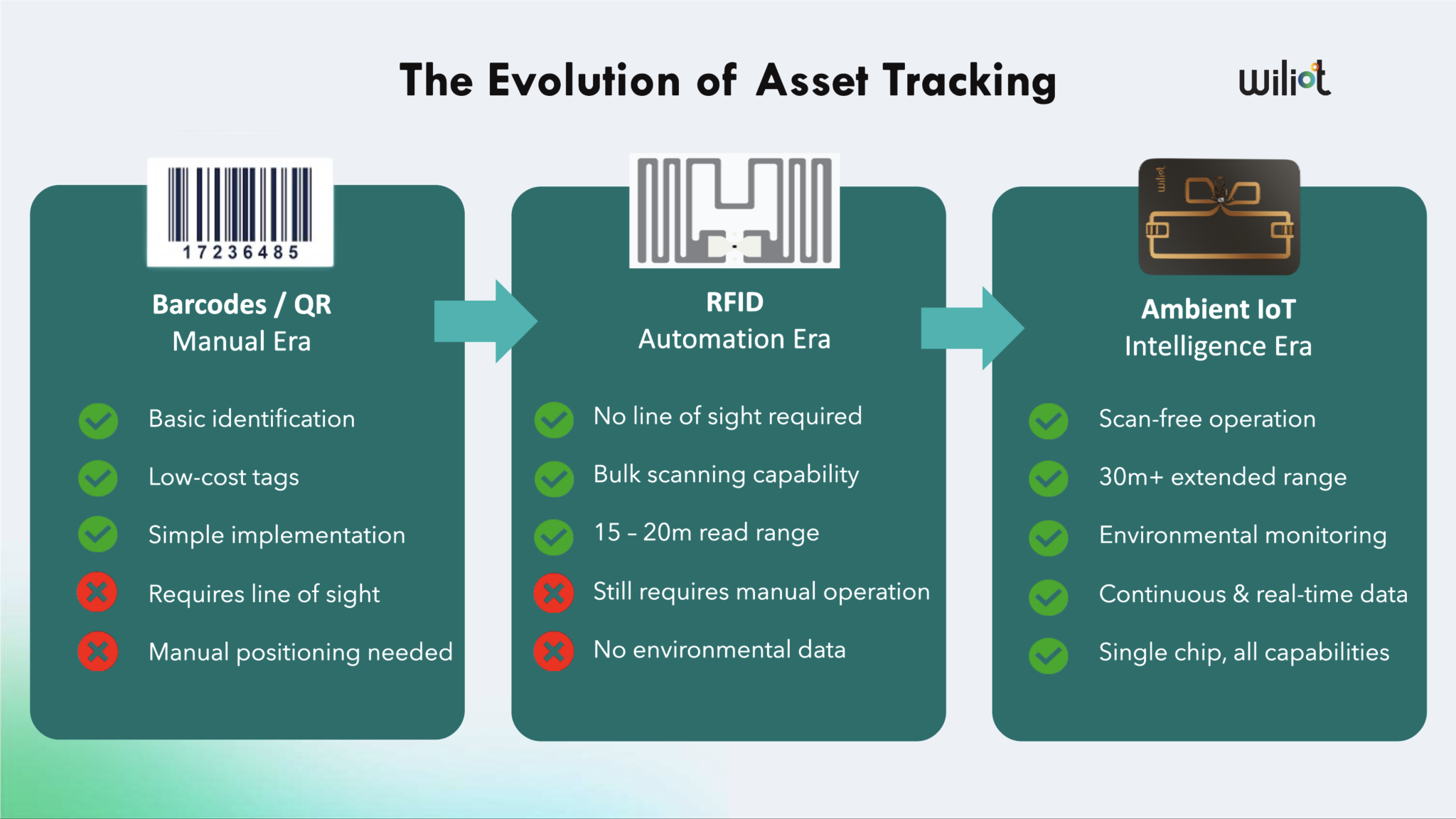
The technology evolution story follows a familiar pattern: barcodes served their purpose, RFID expanded capabilities dramatically, and now Ambient IoT represents the next logical step. This isn't about replacing what works. It’s about addressing the limitations that prevent organizations from meeting today's visibility requirements.
Ambient IoT functions like RFID, but never stops monitoring. Instead of point-in-time snapshots, it provides continuous, real-time intelligence about asset location, movement, and environmental conditions.|
Four key innovations make this evolution possible:
Scan-Free Operation: While tags are still being read, you don't need to manually operate a reader once it's installed. Pull a pallet, crate, or case into a coverage zone, and information automatically transmits to the system. No more missed scans due to human variability.
Extended Range: The next generation of tags can achieve over 30 meter read ranges — nearly double RFID's capabilities. This expanded coverage means fewer infrastructure points and broader monitoring zones.
Unified Multi-Capability: A single chip provides identification, location tracking, and environmental monitoring (temperature, humidity, light) without requiring different readers or system recalibration. One tag, one infrastructure, all capabilities.
Energy Harvesting: These tags harvest energy from ambient radio frequencies, eliminating the battery maintenance headaches that plague traditional IoT sensors while enabling indefinite operation.
How asset tracking has evolved from manual to automatic to intelligence.
Technical and Economic Advantages
The same manufacturing processes that produce RFID tags can create Ambient IoT tags with minimal modifications, enabling competitive pricing at approximately $0.10 per tag depending on volume.
The infrastructure investment offers compelling economics compared to traditional RFID deployments, though specific costs vary by implementation scale and requirements.
Integration happens through standard APIs and modern cloud platforms. Instead of drowning you in data, cloud processing turns millions of data points into actionable insights. The complexity stays behind the scenes while you see enhanced functionality through familiar interfaces.
Where the Evolution Really Matters
While Ambient IoT can enhance virtually any asset tracking operation, certain environments and use cases showcase where this evolutionary step delivers the most dramatic impact.
High-Velocity Environments: Automated conveyor systems, cross-docking facilities, overhead storage, hazardous areas — places where you need visibility but can't easily access for regular scanning.
Process-Intensive Operations: Continuous monitoring reveals workflow bottlenecks and optimization opportunities that periodic scans simply can't capture.
Cold Chain and Compliance: For pharmaceuticals, food products, and chemicals, automatic compliance documentation replaces manual temperature logging, reducing labor costs while improving regulatory adherence.
Perishable and Sensitive Assets: The market increasingly demands visibility into products that could spoil, degrade, or cause harm — capabilities that standard RFID architectures simply cannot provide without significant infrastructure changes.
Making the Evolutionary Transition
The most effective approach treats Ambient IoT as an evolution rather than a replacement of existing RFID capabilities. Organizations can leverage established asset tracking expertise while building continuous monitoring capabilities.
Both systems can operate simultaneously during transition periods. Integration platforms consolidate data from both technologies, providing unified visibility while applications migrate based on business priorities and budget constraints.
This evolutionary approach acknowledges that RFID has limitations without positioning Ambient IoT as direct competition. Instead, it's the natural innovation track for organizations ready to explore what comes next in their technology journey.
Success metrics should focus on operational improvements: inventory accuracy gains, process efficiency increases, labor productivity changes, and risk reduction achievements. These concrete measures demonstrate business impact and justify continued investment.
The Innovation Imperative
Organizations that jumped on RFID early gained lasting advantages. The same opportunity exists with Ambient IoT today.
The reality is that enhanced visibility leads to better decisions. Improved efficiency drives cost advantages. Continuous intelligence accelerates innovation. These benefits compound over time, becoming increasingly valuable as competition intensifies and customer expectations keep rising.
Just as RFID moved beyond the limitations of barcodes while still allowing both technologies to coexist, Ambient IoT addresses RFID's boundaries while building on its proven foundation. The question isn't whether this evolution will happen — it's whether you'll lead it or follow it.
RFID was revolutionary, but the next chapter in asset tracking is here. Are you ready to explore what's possible with Ambient IoT? Contact us to get started.