Uncovering the Layers: Ambient IoT versus RFID Technology in Modern-Day Applications
January 30, 2024
Ambient IoT and RFID are two technologies that can be used to track the location and the condition of items in the supply chain. While the technologies serve a similar purpose, they are different in how they are implemented and the functionality they provide. Ambient IoT is a more recent technology. It leverages a number of the manufacturing and architectural elements that RFID pioneered over three decades while leveraging more recent technologies and addressing gaps and requirements associated with cloud computing, smartphones, commodity radio technologies, and AI. They are both manifestations of automatic identification (Auto-ID) solutions designed to be used in a wide range of applications.
This article will discuss the details of these two technologies and look at how they mesh with modern applications that use the data they generate. We will investigate the advantages and disadvantages of Ambient IoT and RFID in addressing the collection of data meant to improve all aspects of the supply chain in today’s competitive marketplace.
Let’s start by defining these two related technologies and taking a look at their development and core functionalities. Understanding the differences in these technologies is essential to leveraging their capabilities and addressing their ability to meet the needs of modern applications and business requirements.
RFID
RFID stands for Radio Frequency Identification. It is a form of wireless communication that uses electromagnetic fields to automatically identify and track tags attached to objects.
Radio Frequency IDentification can be used very generally. There are vast numbers of different types of radios that can be identifiers for places and things, but the industry tends to use the acronym RFID as a name for a very specific set of technologies that can be understood across two dimensions: frequency, active/passive.
An RFID system is comprised of four components. They are:
RFID tags which act as transponders. An antenna is a mandatory part of a tag. The communication range of an RFID tag is dependent on multiple factors including the type of tag, the radio frequency used, and interference from other RFID tags or the surrounding environment.
A scanning device with an antenna to collect information from RFID tags. The antenna determines the accuracy, speed, and range within which RFID tags can be read.
A transceiver to receive data from the tags. Antennas and transceivers are often coupled in a single device referred to as an RFID reader or interrogator.
RFID software is used to control the system and process the collected data.
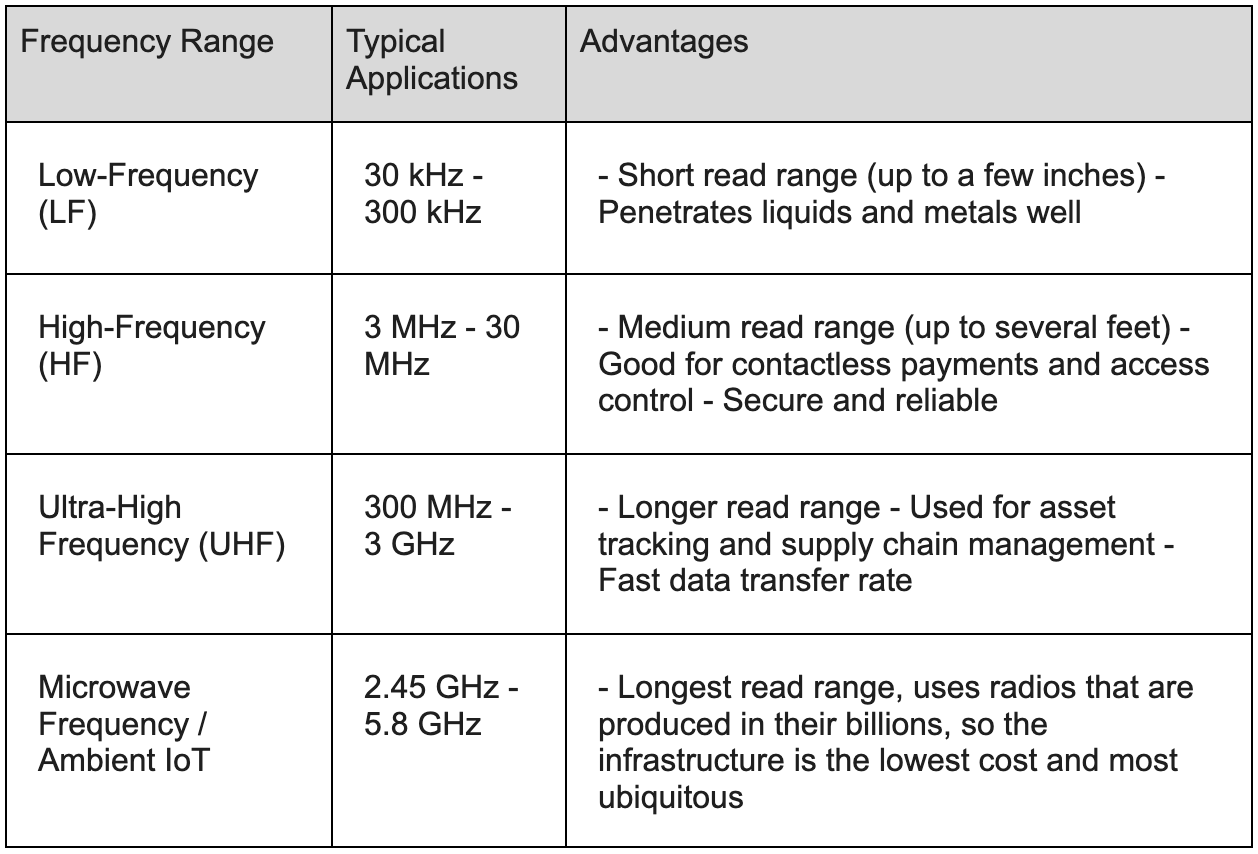
RFID as Defined by Frequency
RFID technology is generally understood based on the frequencies concerned.
If someone in the retail industry talks about their deployment of RFID, they are probably referring to UHF RFID, which operates using Ultra high Frequency tags and readers that communicate in the 900 MHz bands (and lower in some European countries). This type of RFID is promoted by an organization called RAIN, a name taken from RAdio frequency IdentificatioN.
However, someone who is selling an access control system that controls entrance to buildings with credit card-sized tags that often hang from the belts of workers at large companies, will be referring to HF, or high-frequency tags and readers.
The rest of this article will focus on UHF RFID and Ambient IoT.
Active versus Passive RFID
RFID tags can be categorized as active or passive. An active RFID tag has its own power source, typically a battery. Passive RFID tags obtain power from the electromagnetic waves of the reading antenna.
The Origins of RFID
The technology behind RFID has its origins in the post-World War II era. Development in radio frequency communication systems continued throughout the 1950s and 1960s. In 1973, two patents were awarded related to RFID technology which are seen as the birth of modern RFID systems. Mario W. Cardullo received a patent for an active RFID tag with a rewritable memory. Charles Watson also received a patent for a passive transponder that was used to unlock a door.
The 1980s saw further adoption of RFID technology for multiple uses including:
Animal tagging;
Personnel access to restricted areas;
Automating factory processes;
Tagging and tracking items in the supply chain;
Automatically collecting tolls.
Currently, RFID is used in many scenarios. The following are some of the areas where RFID technology is widely deployed.
Automated payment for public transportation systems and toll roads;
Access control for buildings or rooms;
Object tracking and inventory control in warehouses, museums, and libraries;
Animal and pet identification;
Logistics and asset management.
Ambient IoT
Ambient IoT represents an evolution of RFID that introduces enhancements and new capabilities. Combined with the use of emerging complementary technologies such as cloud computing, Ambient IoT is designed to fulfill the original aims of UHF RFID and the Internet of Things. The technology offers the potential to effortlessly monitor the location, condition, and state of virtually any item during and after its time spent in the supply chain.
The concept of Ambient IoT relies on the pervasive nature of smart devices that were not available when RFID was developed. Replacing expensive and dedicated RFID readers with a network of billions of potential data receivers vastly increases the types of applications that can use Ambient IoT technology.
Ambient IoT is built with security in mind to address privacy concerns that affect RFID communication. Security is crucial in today’s connected environment, and the lack of strong security has hindered the effective use of RFID in many scenarios.
Ambient IoT provides real-time visibility into the condition and location of goods and materials. It provides sensor-based intelligence to promote the interaction of items that can benefit from this type of awareness. It is a groundbreaking technology that has the potential to radically change the way businesses and consumers interact with the world.
Comparing RFID and Ambient IoT Functionality
It’s instructive to compare the base functionality of RFID and Ambient IoT when determining their potential to address business or regulatory requirements. Essentially, an RFID system takes a strong signal from a tag and reflects a weaker one to a reader.
Ambient IoT employs the opposite approach. Ambient IoT devices harvest energy over a short period from weak signals harnessed from low-cost radios present in the existing and surrounding infrastructure built using commodity radios and produce stronger signals to transmit data to cloud-based apps.
The basic functionality of all RFID systems follows a similar pattern.
Information stored on an RFID tag lies dormant and is ready to be read.
The tag’s antenna picks up electromagnetic energy from a dedicated reader’s antenna.
The tag employs internal energy or power obtained from the reader to transmit radio waves to the reader.
The transmission by the tag is a reflection of the signal from the reader whereby the original signal received is remodulated or changed to encode information from the tag.
The reader collects data from the tag and forwards the information to RFID software.
This is similar to someone stranded on a desert island using a compact mirror to reflect the rays from the sun to signal to a passing rescue plane. A great technique if the plane flies by during the day when the sun is out.
Ambient IoT collects data using an alternative approach. Rather than relying on the dedicated readers employed in an RFID system, Ambient IoT makes use of the available energy all around us. Ambient IoT harvests energy from the radio waves generated by everyday devices like smartphones and tablets. It then uses this energy to communicate with other devices or applications.
The ability to exchange data with a wide variety of low-cost, pervasive devices that surround us - immediately differentiates Ambient IoT from RFID. Information can be obtained without the expense of RFID readers by communicating with apps running on smartphones or other smart devices. This ability paves the way for the fine-grained monitoring that will become essential to optimize supply chains, address customer concerns, and contribute to operational sustainability.
RFID and Ambient IoT Standards
The development of standards that facilitate compatibility and interoperability is key to the effective use of any technology. RFID and Ambient IoT devices are manufactured to conform to various sets of standards that enable them to be used to construct complex identification systems.
ISO/IEC 18000 Series: This umbrella standard covers various aspects of RFID, including:
Air interface protocols: Defining how tags and readers communicate using different frequencies (LF, HF, UHF) and modulation schemes.
Tag data structures: Specifying how data is organized within an RFID tag's memory.
Anti-collision protocols: Preventing multiple tags from responding simultaneously and interfering with each other's signals.
Security mechanisms: Protecting data stored on tags and during communication with readers.
Ambient IoT standards
Three complementary sets of standards are being defined to further the interoperability of Ambient IoT systems. Wiliot contributes to the development of these standards and is committed to supporting them. The following bodies are responsible for Ambient IoT standards.
Bluetooth SIG - The Bluetooth Special Interest Group oversees the development of Bluetooth standards used in Ambient IoT technology today.
The Third Generation Partnership Project (3GPP) is comprised of seven organizational partners from Asia, Europe, and North America. This body defines the 5G telecommunication standards used by mobile phones for voice and data communication. 5G Advanced will include its own implementation of Ambient IoT which will have the force of the telecommunications industry behind its sales and marketing and will have the networking capability that will open up access to Ambient IoT tags to any company across any 5G Advanced telecommunications device.
The Institute of Electrical and Electronics Engineers (IEEE) is also working on standards that will support Ambient IoT device functionality across the Wi-Fi devices that are sold and marketed by the large makers of wireless infrastructure implemented in home, public, and enterprise environments
Advantages of Ambient IoT
Ambient IoT offers multiple advantages over other auto-ID solutions such as UHF RFID. The following benefits give Ambient IoT the edge in many current and future applications.
Minimal labor requirements - It costs money to pay employees to manually scan RFID tags. Since ambient IoT readers chips are made in their billions and the cost of devices is lower and thanks to Bluetooth, 5G Advanced, and Wi-Fi standards their presence is spreading so that the reading of tags can be done without manual intervention by devices that are listening everywhere tags are likely to be.
Increased visibility and Pervasive coverage - Leveraging the universal coverage afforded by the prevalence of Bluetooth-capable devices means that rather than reading RFID tags at a small number of choke points using expensive fixed tunnel readers or handheld devices entire facilities can be covered with readers tracking not just the entry into a facility but the movement of tracked items as they move around a warehouse, store, vehicle, or home.
Personal device and appliance integration - Individuals can integrate personal devices and home appliances into an Ambient IoT system. This facility opens the door to many new applications that further the concept of the smart home. Having smart packaging in the home opens up a direct connection between manufacturers of products and their users.
Privacy and data ownership - Users can maintain ownership of their data in an Ambient IoT environment. They will have the option to opt-in to data collection which in many cases will provide them with enhanced opportunities and services. The focus on privacy concerns promotes regulatory compliance when personal data is in scope.
Security - Ambient IoT was developed in the age of cloud computing where security is a priority. Conversely, RFID was developed without security in mind. More secure applications are possible using Ambient IoT. While RFID tags have security options, these are rarely used and they do not provide the robust end-to-end security required for connected medicine, clothing, and other personal products
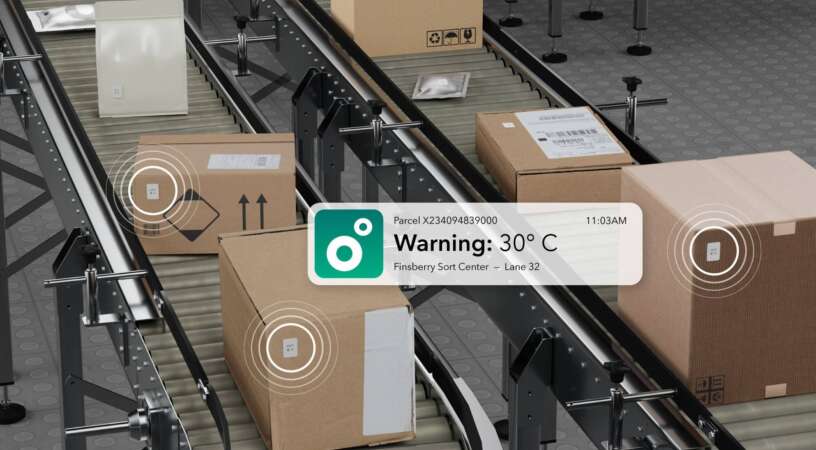
Sensing - Ambient IoT devices have always had temperature sensing as a base capability in every tag, with options to detect packaging being opened and closed and chemical changes in products that can help measure the freshness of food and other useful conditions. Similar concepts were explored with RFID but they were always confined to nice, very high-priced variants.
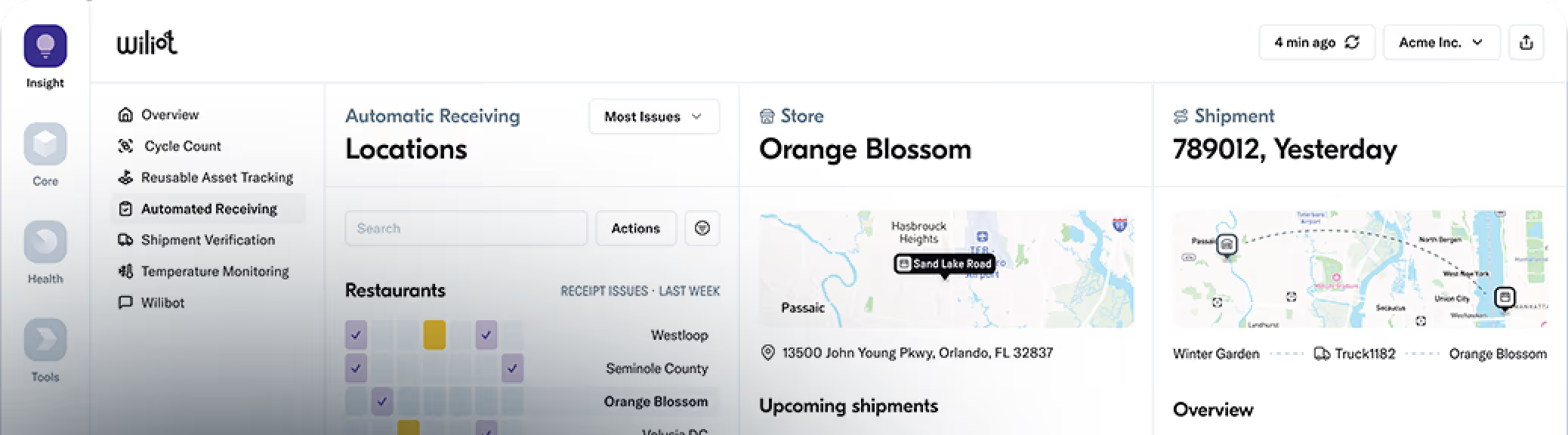
Real-time data processing - Ambient IoT can sense item movement and provide the raw material for real-time data processing. The data is pushed to the cloud, allowing triggers and events to be initiated based on changes in the physical world without manual intervention by staff or consumers. Sophisticated mobile and enterprise apps can be developed on the backbone of an Ambient IoT system that collects and transmits data to the cloud.
Network connectivity - The ability to network Ambient IoT devices allows for scalable solutions that can encompass trillions of endpoints, spanning huge numbers of locations with the data being forwarded to the owner independent of location or reading device. This isn't a concept in the world of UHF RFID which predates the development of the Internet or cell phone networks.
Disadvantages of Ambient IoT
Several disadvantages of Ambient IoT should be fully understood before embarking on deployments. Following are some of the possible issues that may impact the adoption of Ambient IoT solutions.
Maturity - Ambient IoT is a newer technology with a limited ecosystem of device manufacturers, converters, or consultants that understand how to realize its potential. This may impact the ability of organizations to find appropriate solutions for their business requirements.
Privacy - Given the ability to connect so many of the things we use, privacy concerns may exist over how data collected by Ambient IoT devices is stored and used.
Economies require scale - While Ambient IoT has a potential scale orders of magnitude greater than UHF RFID it has yet to reach these scales and so RFID still has a cost advantage concerning tags, which are still produced in greater volumes for RFID.
Connectivity - Today Ambient IoT requires cloud network connectivity to communicate with applications that process its data. In the future it's likely there will be a full range of on-premise and offline versions of the technology but today it requires a cloud-based model.
Few Applications - The new paradigm of a unique digital passport for every single thing will require applications to unlock the full value. There are very few applications written that exploit the potential of ambient IoT connectivity applications serialized. Most enterprise applications are still working using legacy paradigms, e.g. tracking items at an SKU level.
Understanding - Like any powerful technology such as the internet, AI, or the smartphone, in the early years the full application of what can be achieved takes time to be fully understood.
Companies may be challenged to make effective use of the wealth of information available from Ambient IoT systems. The volume and variety of available data can be overwhelming and have to be incorporated into business processes. Organizations may need to adopt a methodical approach to changing their processes when moving to Ambient IoT technology.
Advantages of RFID Technology
RFID technology has several advantages that may make it the appropriate tracking solution in some usage scenarios. Following are some of the advantages of RFID technology.
RFID tags are relatively inexpensive and offer a low-cost solution for automatic identification.
The technology has been proven over many years and is optimized for snapshots of supply chain items.
RFID has a minimal dependency on network infrastructure or cloud resources.
Manufacturers have developed a large selection of RFID tags appropriate for different materials.
Disadvantages of RFID
RFID also has several disadvantages when compared to Ambient IoT that can impact its viability as a monitoring and tracking solution.
An RFID implementation requires an expensive infrastructure consisting of RFID readers.
Tag capacity is limited regarding the amount and type of data that can be collected and processed.
Range and frequency limitations and interference can impact communication between RFID tags and readers.
RFID presents limited data processing capabilities due to a lack of integration with the cloud and smart environments.
Security is a concern because in most cases anyone with a compatible reader can access the data from RFID tags.
The limitations and drawbacks of RFID make it challenging to use as an auto-ID solution in some situations.
Industry Applications of RFID and Ambient IoT
The auto-ID capabilities provided by RFID and Ambient IoT support applications used in a wide variety of industries. Following are some examples of industries deploying auto-ID solutions and a comparison of how the two technologies address their objectives and requirements.
Retail
Retail establishments were early adopters of RFID technology to manage inventory and monitor purchases. Specific retail sub-sectors make extensive use of auto-ID.
Apparel - The apparel industry leverages the functionality of auto-ID for inventory management, and monitoring purchases. RFID is suitable for these purposes and has been used for many years. Ambient IoT enables additional tracking of movement within a facility and continuous updates on changes, as well as the potential of information to be collected after a garment has been purchased and left the store. This data can be used to improve customer satisfaction and sustainability.
If an occasional snapshot of inventory is sufficient to meet the business requirement, or tag cost in the short term is paramount and the labor overhead along with limited visibility of snapshots are not disqualifiers, then RFID will have an advantage over ambient IoT.
Grocery & QSR - The food industry can greatly benefit from the real-time data processing and sensing capabilities of Ambient IoT. The condition and location of perishable commodities can be efficiently monitored to ensure freshness for consumers. Business owners and managers can use available information to optimize supply chains and provide customers with reliable information regarding the sustainable processes used to produce their food.
RFID offers a well-understood and proven technology for periodic snapshots of inventory. If hand-held scanning with the labor costs and potential discrepancies that come with manual processes is acceptable, then RFID may be the preferred choice, especially for buyers who prioritize technologies later in the adoption curve.
Ambient IoT provides cold-chain tracking as standard and higher process compliance as the reads are automated.
Healthcare
The healthcare sector makes extensive use of auto-id capabilities. RFID and Ambient IoT offer healthcare professionals a method to track patient movement, medications, and the use of medical equipment. Once again, Ambient IoT proves to be more flexible by not requiring manual scanning with more expensive RFID readers. The additional information available from an Ambient IoT installation enables greater visibility and a more automated solution. For solutions that require the use of a variety of tags tuned to different materials, RFID has a broader catalog of tags developed over many years. It will be a few years before ambient tags will be developed for the multitude of materials and use cases that RFID has been adapted to address.
Supply Chain
Ambient IoT and RFID are used to manage supply chains, track inventory, and monitor assets. RFID systems are best suited to provide inventory snapshots at specific points in the supply chain. Ambient IoT can sense the movement of items throughout the supply chain, providing additional information that improves management and enables corrective action to be taken immediately when issues arise.
Automotive
Automobile manufacturers use RFID to track parts and document quality control throughout production. When customers have issues with a part, they have to bring it to a service center or dealership to scan the item. Ambient IoT eliminates this requirement and makes it possible for parts to be traced throughout their lifecycle by connecting through an app on a customer’s smartphone. Where short-term tag cost is paramount and visibility, coverage, or labor costs are not then RFID has an advantage.
Postal and Logistics
RFID technology has been used in the postal and package delivery industry. Drivers and delivery personnel typically use handheld RFID readers to collect data from a package. Ambient IoT enables information about the package or item to be obtained in many more read points such as in transit readers that are being installed in trucks and delivery vehicles. In the future with ambient IoT networks, there will be the potential to track parcels after they have been delivered and in the event there is theft of deliveries left on the doorstep. Customers can opt-in to data collection with an Ambient IoT device.
Future Trends
Ambient IoT and RFID technology will continue to play an important role in society and the industries previously discussed. The market for Ambient IoT is expected to grow rapidly to address a 10 trillion unit addressable market according to the Bluetooth SIG as more organizations adopt cutting-edge technology such as Wiliot’s IoT Pixels.
The integration of RFID systems with Ambient IoT intelligence will reshape the way organizations manage supply chains and deliver products to consumers. Companies in the RFID industry are in an excellent position to take advantage of Ambient IoT by retooling. These organizations can leverage their familiarity with auto-ID and related standards and get a head start on new competitors.
The knowledge these companies have regarding auto-ID solutions and the challenges faced using RFID in specific cases will promote research and development into Ambient IoT. Many of the tag production technologies and facilities can be modified to produce Ambient IoT devices.
Challenges for the traditional auto-ID market may slow down the adoption of Ambient IoT solutions. Following are some of the specific challenges that must be overcome for Ambient IoT to reach its full potential
Experts in RFID technology may have difficulty adapting to the differences presented by Ambient IoT. Some organizations may delay switching to the new technology in favor of their proven solutions. Companies that are fully committed to Ambient IoT can make significant inroads in their market sector by taking advantage of its advanced features and functionality.
Ambient IoT presents new paradigms that must be learned and incorporated into business practices. The focus will be on visibility over time instead of snapshots to identify choke points. Streaming data from Ambient IoT enables sensing rather than scanning which may take some time for organizations to assimilate.
Business models need to change as the tags and readers associated with RFID are commoditized with new revenue streams focusing on recurring services.
New 3GPP, IEEE, and Bluetooth standards must be adopted by device manufacturers to enable widespread use of Ambient IoT technology.
Conclusion
Ambient IoT and RFID are important technologies that will continue to be used in a wide range of industries and usage scenarios. The advantages of Ambient IoT will make it the preferred technology over time. Its cost-effectiveness, ability to enable pervasive end-to-end visibility, with real-time event capabilities, and ability to connect retailers and manufacturers directly to consumers while addressing privacy needs make it more suitable for a majority of uses.
The implications of a world connected through Ambient IoT cannot be overstated. Individuals will have the opportunity to opt-in to Ambient IoT systems to access many new kinds of services including the visibility of detailed digital product passports that prove the origin, authenticity, and ingredients of the products they purchase, empowering them with a new power to influence the supply chains they fund. Companies can leverage the wealth of information available from Ambient IoT for competitive advantage, reengineering processes, drastically optimizing supply chains, and increasing customer intimacy, and retention.
There are huge opportunities to bring more effective healthcare outcomes with better data including regimen adherence. Most significantly, ambient IoT offers the ability to meet the needs of the climate crisis with much more efficient supply chains, more circularity, less waste, and real-time visibility of carbon to every stakeholder, making ambient IoT one of our most potent weapons to fight climate change and a more stable and sustainable economy.