RFID creates choke points at fixed read points. Our scan-free solutions provide continuous visibility with the lowest cost infrastructure, delivering real-time supply chain intelligence while minimizing errors, reducing waste, and driving ROI across enterprises.
Comparing RFID, Bluetooth Beacons, and Physical AI: Why the Differences Make All the Difference
May 26, 2026
Supply chain visibility has historically depended on identification. A barcode, RFID tag, or beacon tells a system that a product, pallet, or asset was seen at a specific place and time.
That model still matters. It helps companies confirm inventory, validate movement, and reduce manual error. But it is no longer sufficient for supply chains expected to operate in real time.
Retailers need to know what is on the shelf, what is in the backroom, and what is already in motion. Grocers need to know whether perishable goods remained within acceptable conditions. Logistics teams need to detect shipment errors before trucks leave the dock. AI systems need live physical-world data before they can make useful operational decisions.
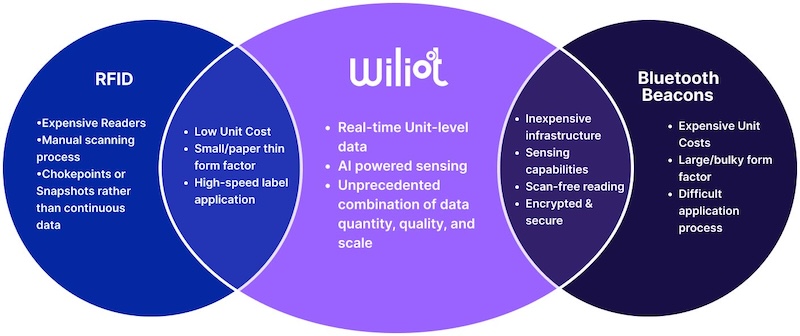
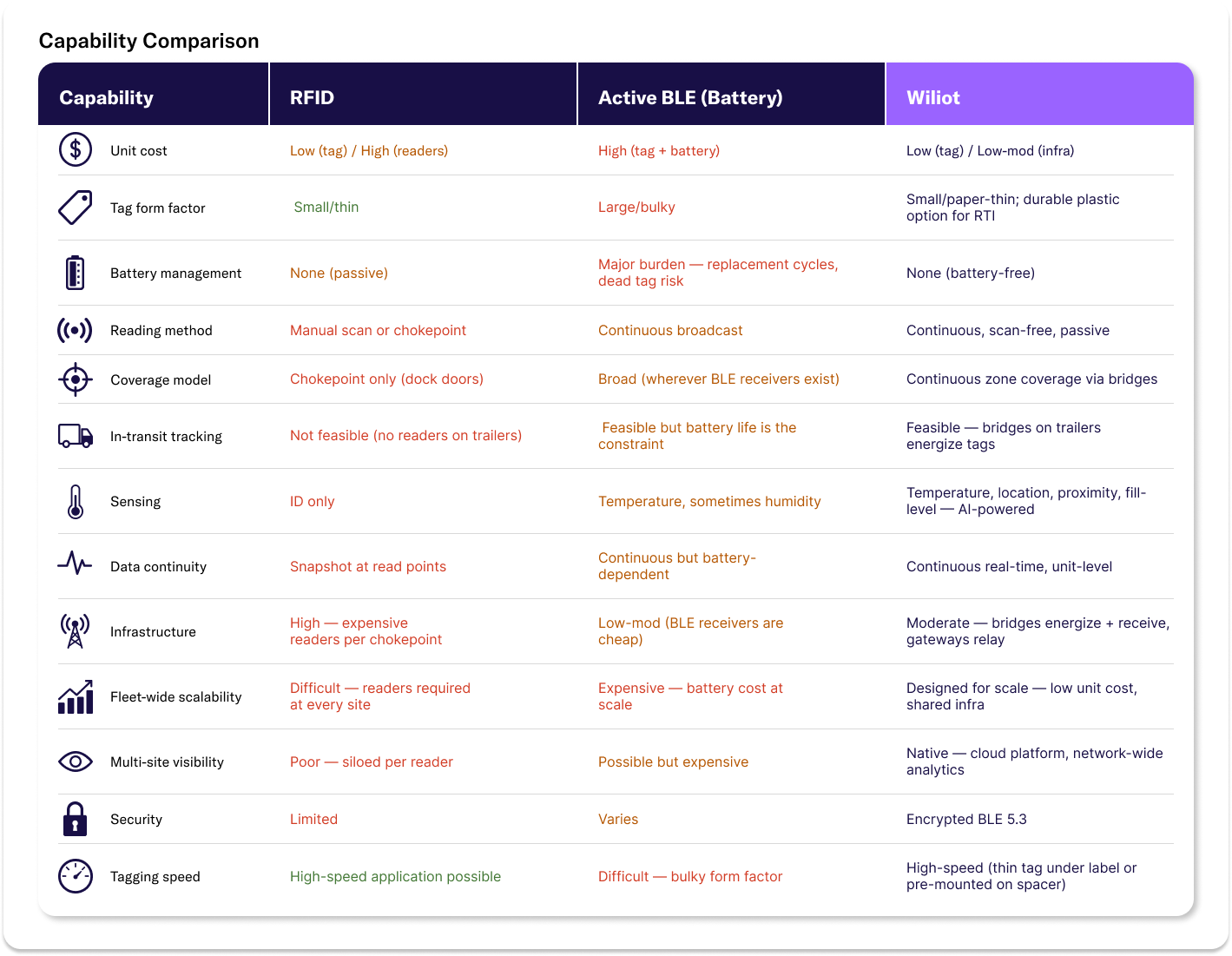
That requirement changes the technology discussion. This blog breaks down two legacy visibility technologies – RFID and active Bluetooth Low Energy (BLE)/Bluetooth beacons – and compares them with Physical AI. The central question is whether an asset can continuously generate the data supply chains need to sense, understand, and act.
RFID Is Built for Chokepoints, Not Continuous Awareness
RFID is mature, proven, and effective in controlled environments. It is especially strong in high-throughput facilities where large numbers of tagged items move through defined read zones. Passive RFID tags are thin, low-cost, and well suited for item-level identification. In categories such as apparel, warehouse inventory, and scan-gate workflows, RFID can deliver strong performance.
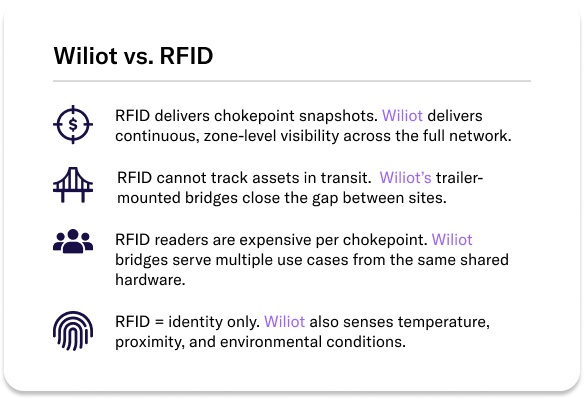
Its limitation is the operating model. RFID depends on readers installed at specific locations. It can confirm that an item passed a chokepoint, but it cannot easily explain what happened between read events.
That gap is becoming critical for many retailers. A pallet may be scanned at a dock door, then remain invisible in transit. A case of perishables may be identified, but not continuously monitored for temperature exposure. A reusable asset may leave a facility and disappear into a distributed network until it passes another reader.
RFID answers an important but narrow question: “Was this item detected here?” Today’s supply chains need to know where assets are now, what condition they are in, and whether action is required.
Active BLE Adds Sensing, but Batteries Limit Scale
Active BLE beacons address a different visibility problem. Instead of waiting for a scan, battery-powered tags continuously broadcast signals to nearby receivers. That makes them useful for real-time location tracking, cold-chain monitoring, and higher-value asset visibility.
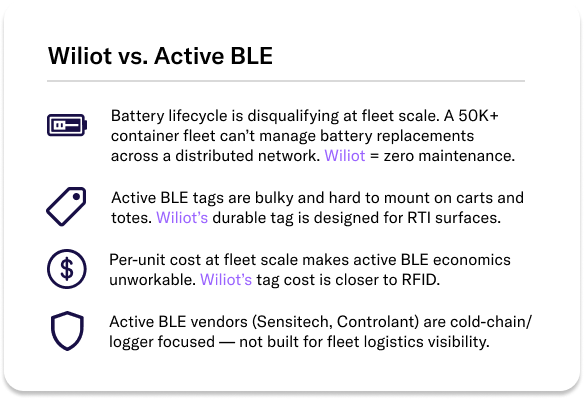
Active BLE improves on checkpoint-based visibility because it can provide more frequent signals and support sensing, including temperature or humidity in some deployments. For assets valuable enough to justify the tag cost and maintenance model, active BLE can be effective. But the challenge is scale.
Battery-powered tags are larger, more expensive, and harder to manage across distributed operations. A deployment involving tens of thousands of crates, totes, roll carts, pallets, or containers creates replacement cycles, dead-tag risk, field service requirements, and ongoing maintenance work.
Active BLE provides continuous monitoring, but its economics and maintenance burden become harder to defend as asset counts rise and networks become more distributed.
Physical AI Delivers Continuous Intelligence Without Battery Management
Wiliot’s Physical AI platform is designed for supply chains that need continuous intelligence without manual scanning or battery management.
At the edge, Wiliot IoT Pixels are small, battery-free Bluetooth sensors that harvest ambient radio-frequency energy. They can be attached to products, cases, pallets, reusable assets, and packaging. They generate data about location, movement, temperature, humidity, light, proximity, fill level, and other physical conditions.
That data is processed by the Wiliot Physical AI platform. AI and machine learning models convert raw physical signals into operational events: a misplaced pallet, a delayed shipment, a temperature excursion, a missing asset, an incorrect load, or a product sitting too long in the wrong environment.
This is the core distinction. Wiliot combines RFID’s scalability, active BLE’s sensing capability, and an AI platform that turns physical-world data into action. It creates a continuous data layer that enterprise systems can use to automate decisions across the supply chain.
The Business Case Is Operational Performance
The strongest case for Physical AI is measured in outcomes.
In reusable asset tracking, Wiliot helped a leading European logistics company exceed well beyond its goal of 95% crate visibility every 20 minutes. The deployment achieved 95% visibility in 30 to 40 seconds – roughly 30x faster than the goal set, 99% visibility within 15 minutes, and 5-10x lower infrastructure costs than comparable RFID alternatives.
Across broader deployments, Wiliot’s platform is operating at production scale: over 100-million assets tracked daily across 20,000 sites; 1.25TB of data ingested per day; 235 million events generated daily; and 38 machine learning models applied continuously.
Those data volumes translate into measurable impact. Wiliot deployments have improved inventory accuracy to 99%+, reduced dock-to-stock time from 24-48 hours to 2-6 hours, reduced receiving labor by 30-50%, reduced mis-shipments by up to 90%, and reduced lost, damaged, and delayed packages by 60%.
These results come from a specific technology advantage: when products and assets continuously generate physical-world data, operations can detect issues earlier, automate more decisions, and reduce dependence on manual verification.
Physical AI Has Become the Definitive Supply Chain Technology
RFID and active BLE helped define earlier eras of supply chain visibility. RFID made identification faster and more automated at fixed points. Active BLE added more frequent signals and condition monitoring for higher-value assets.
But today’s supply chains require continuous, battery-free, AI-ready intelligence across distributed networks. That is why Physical AI has become the definitive supply chain technology.
It gives products and assets the ability to continuously communicate their identity, location, movement, and condition. It gives AI systems the data needed to understand what is happening in the physical world. And it gives operators the ability to act before exceptions become failures.
RFID identifies. Active BLE monitors. Physical AI enables the supply chain to sense, understand, and act continuously


%201.svg)

%201.svg)

%201.svg)
%201.svg)
.svg)


.svg)
.svg)



.avif)



.jpg)






.webp)