For decades, RFID was seen as a savior of enterprise logistics. It promised an end to barcode scanning and manual inventory tracking, while offering companies a digital glimpse into operations.
But in today’s lightning-fast, dynamic marketplace, RFID has shown its age. As supply chains grow more fragmented and expectations rise, outdated RFID technology isn’t a salvation – it’s a chokepoint. It’s essentially a passive, point-in-time tracking technology in a world that demands ubiquitous, real-time intelligence.
In light of everything that stresses today’s supply chains – great expectations, unrelenting demand, labor challenges, geopolitical disruptions, climate risk, and regulators focused on traceability and sustainability – enterprises must transition from the old to the new; from the buggy to the car; from episodic scanning to continuous visibility.
The “new” is Physical AI, powered by Wiliot.
Get the RFID vs. Wiliot Comparison Guide
The Old: Ghosts in the Supply Chain
RFID works like this: A crate of goods arrives at a distribution center, a worker triggers a handheld scanner or passes it through a fixed chokepoint portal, and a system registers the crate was there at that point in time.
But what happens 20 minutes later? What happens if the crate is loaded onto the wrong truck, or left out on a hot tarmac, or buried under 10 other crates in a dark corner of a warehouse? Hard to say.
RFID tracking leaves supply chains riddled with blind spots – potential problems that can’t be “seen.” Moreover, it doesn’t provide contextual insight. RFID can’t tell you if the temperature spiked and spoiled a shipment of dairy, nor can it alert you if a crate of fresh produce sat too long, cutting into its shelf life. It is deaf, dumb, and blind between scans.
This static architecture also creates data gaps; incomplete information that leads to shrinkage, over-production, stock-outs, and waste. In order to get up-to-speed, a modern supply chain must abandon the scan altogether.
The New: From Visibility to Action
Physical AI requires no scanning, yet it creates continuous visibility throughout the supply chain. This is the innovation that leaves RFID behind.
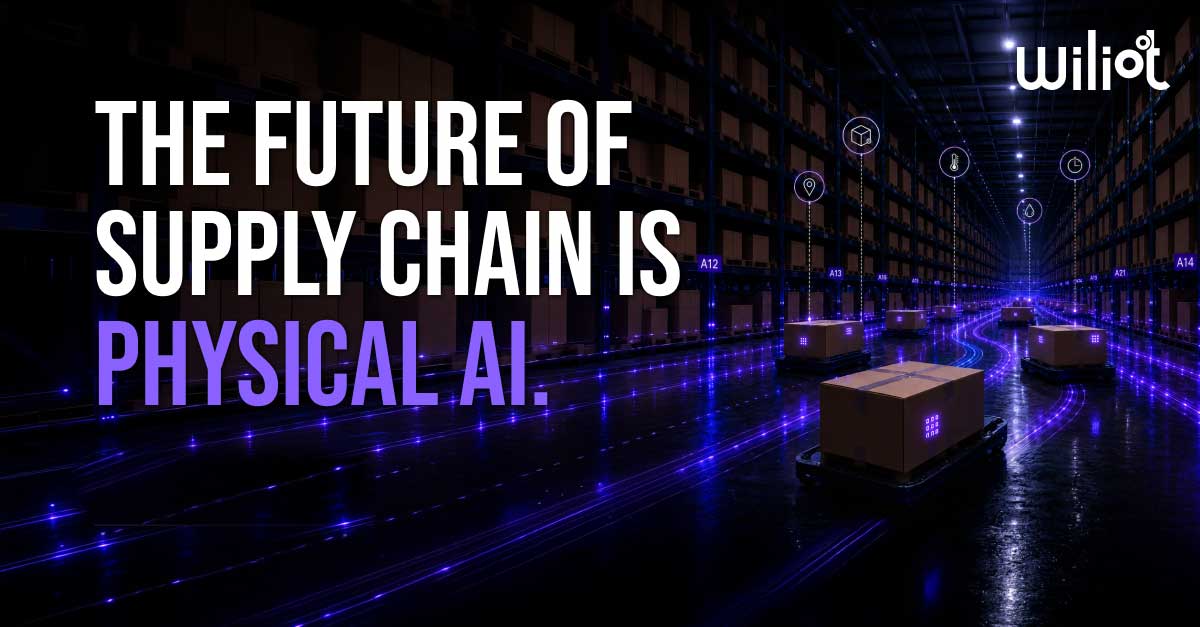
Wiliot has reimagined the tracking layer of supply chain management by adding digital intelligence to everything in the chain. Wiliot IoT Pixels are small, inexpensive, battery-free Bluetooth sensors that harvest ambient RF energy and attach to products, cases, pallets, reusable assets, and packaging. IoT Pixels continuously generate data about location, movement, temperature, humidity, light, proximity, and other physical conditions.
No blind spots; no gaps.
The data is then processed by the Wiliot Physical AI platform, using AI and machine learning models to convert raw signals about the physical world into real-time, operational events: a misplaced pallet, a delayed shipment, a temperature excursion, a missing asset, an incorrect load, or a product sitting too long in the wrong environment.
Based on this continuous data layer describing actual events in warehouses, trucks, distribution centers, etc., today’s supply chain management systems can now automate decision making and truly optimize operations. Only Physical AI can pull this off.
Get the RFID vs. Wiliot Comparison Guide
Up-to-Speed: The Real-World Impact
The business implications of moving from dated RFID to Wiliot’s modern Physical AI platform are profound across verticals:
- Food and Beverage: Retailers can track the precise temperature history of produce from farm to fork. This drastically reduces food waste, guarantees freshness, optimizes shelf-life rotation, and allows for targeted recalls instead of discarding entire product lines.
- Retail and Inventory: Instead of performing weekly or monthly inventory counts with handheld RFID guns, store managers gain a real-time dashboard of exact stock levels down to the individual item. Shrinkage is flagged instantly, and omnichannel fulfillment becomes flawless because online inventory accurately reflects physical store shelves.
- Sustainability and Carbon Tracking: True sustainability requires visibility. Because Wiliot tracks products throughout their lifecycle, organizations can accurately calculate the carbon footprint and supply chain efficiency of every asset, eliminating the guesswork from emissions reporting.
- In-Transit Visibility: RFID goes dark the moment a shipment leaves the dock, only picking it back up at the next gate. Wiliot extends its continuous location and condition visibility into the truck or trailer itself — turning transit from a blind spot into a monitored leg of the journey.
Companies are already seeing the benefit of adopting Wiliot Physical AI instead of RFID. A leading European logistics company gained 99% visibility of all its crates within just 15 minutes — at infrastructure costs up to 10X less than comparable RFID alternatives.
Across deployments, Wiliot’s Physical AI platform is tracking more than 100 million assets daily across 20,000 sites. It is ingesting 1.25TB of data and detecting 235 million supply chain events every day.
Such volumes lead to measurable impact. Wiliot Physical AI has boosted inventory accuracy to 99+%; slashed dock-to-stock time from 24-48 hours to 2-6 hours; cut receiving labor by 30-50%; and reduced mis-shipments by up to 90% and lost, damaged, and delayed packages by 60%.
No old-school tracking technology – RFID or otherwise – can accomplish the same. This is the future, here today.
The Future is Continuous
The supply chains of tomorrow cannot be managed with the tools of yesterday. RFID served its purpose in a simpler time, but its reliance on episodic scanning, expensive infrastructure, and manual intervention has made it a bottleneck in the modern digital enterprise.
Wiliot’s Physical AI platform offers the most viable path forward. By giving every product intelligence and enabling continuous visibility, Wiliot sheds light into every corner of the supply chain and brings companies completely up-to-speed. It is time to stop scanning the past and start sensing the present. Welcome to the era of continuous, autonomous, and intelligent supply chains.
Get the RFID vs. Wiliot Comparison Guide


%201.svg)

%201.svg)

%201.svg)
%201.svg)
.svg)


.svg)
.svg)

.svg)
.svg)


.avif)




.avif)





.webp)