Most supply chain teams don't have a data shortage. They have dashboards for inventory, dashboards for shipments, dashboards for labor, and a weekly report that ties them together. What they're short on is the step after the dashboard: knowing what actually happened when something goes wrong, and what to do about it while there's still time.
That's the gap operational intelligence is meant to fill.
Operational intelligence (OI) is real-time analysis of live operations that detects an exception, explains what caused it, and points to the next action while the problem is still solvable. Gartner frames operational intelligence as real-time insight into live business operations. For supply chain teams, the practical test is simpler: does the system help you close the exception, or just tell you it exists?
Dashboards Tell You Something Is Wrong. Then They Stop.
A dashboard is good at one thing: showing you a number that changed. Inventory variance at a location is up. On-time shipments dipped. A cooler's average temperature crept higher.
What it usually can't tell you is why. So the alert becomes the start of a manual investigation. Someone pulls paperwork, calls receiving, walks the staging lanes, asks the shift lead what they remember. By the time the answer turns up, the truck has left, the order has been promised, or the product has been written off.
This is the core difference between business intelligence (BI) and operational intelligence. BI looks back across days, weeks, and quarters to show trends and recurring problems. That's valuable for deciding what to change next month. OI works inside the live process, and its job is to help someone make a decision before the current order, shipment, or shift moves on.
An Adjustment Isn't a Resolution
Here's a pattern most inventory teams will recognize. A location comes up short. Someone recounts, confirms the shortage, and posts an adjustment. The variance disappears from the report.
But the exception isn't closed. Nobody knows whether the product was short-shipped, mis-received, put away in the wrong spot, damaged, or counted against the wrong SKU. The number got fixed. The cause didn't. And it'll probably happen again next week.
Operational intelligence raises the bar for what "resolved" means.
An exception is closed when the team can say what happened, where it happened, and who owns the next action. That takes evidence. And evidence takes the right kind of data.
What Real-Time Operations Management Actually Requires
Operational intelligence rests on three inputs working together.
Live signal. OI depends on catching a change while the goods are still in a process window where someone can act. PwC's research on supply chain operations points to visibility across suppliers, logistics, and inventory as what lets teams spot risk early and get ahead of it. Data that shows up at the end of a shift, or after the next scan, shows up too late.
Context. A raw signal says something was observed. Context says what it means: which item, against which order, at which location, at what step in the process, in what condition. Without context, every signal is just another alert.
Correlation. A missing case at pick often traces back to receiving, putaway, or a temperature hold upstream. OI connects related events so the system points to a likely cause instead of sending people on a floor-wide search.
The hard part is the first one. Most supply chain systems record transactions: an order created, a receipt confirmed, a shipment dispatched. They're accurate at those moments and quiet in between. That's not a flaw in your WMS or ERP. It's simply not what they were built to observe. But it means the evidence OI needs, what physically happened between transactions, usually doesn't exist anywhere.
The Sensing Layer Behind Operational Intelligence
This is where Physical AI comes in.
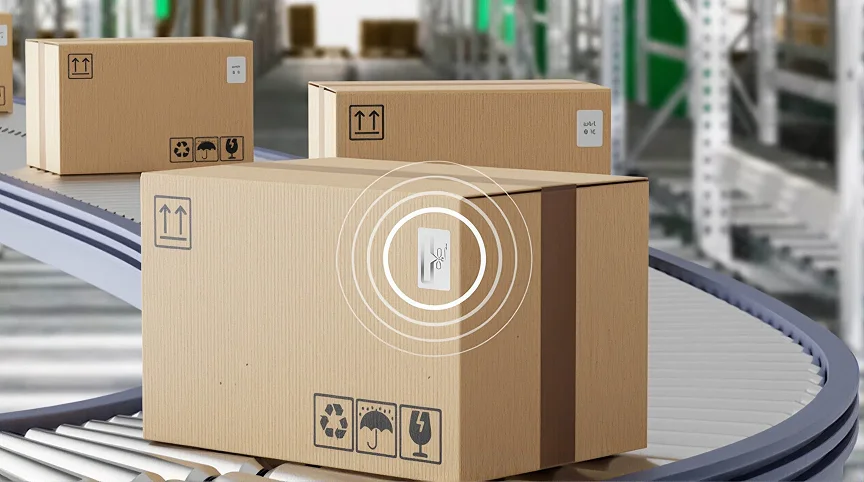
Wiliot's battery-free IoT Pixels attach to items, cases, totes, and pallets and report location and condition continuously, typically multiple times a minute, with no manual scans or fixed read points. That stream flows into the Wiliot Physical AI Platform, which refines raw signals into contextualized events. Its AI models learn normal dwell-time and movement patterns, so a deviation triggers an alert before it turns into a mis-ship or a temperature excursion.
Put that against the exceptions above, and the investigation looks very different:
- A short receipt surfaces at the dock door, where Automated Receiving flags the gap against the expected shipment, not three days later at the pick face.
- A case that leaves its expected area without a matching transaction shows up right away in Inventory Intelligence, with a last-seen location attached.
- An outbound load is checked against the order before the truck leaves with Automated Shipment Verification, so a mis-ship becomes an exception at your dock instead of a chargeback at your customer's.
- A temperature hold comes with a continuous, item-level condition record from Temperature Monitoring, so quality teams can decide what to release and what to quarantine based on what each case actually experienced.
In every one of those cases, the system doesn't just say "variance found." It shows what changed, where the evidence points, and who should act.
Why Operational Intelligence Matters for Agentic AI
The next step for operational intelligence is autonomy: agentic AI that doesn't just recommend an action but takes it. Initiating a transfer. Holding a shipment. Filing a claim. Triggering replenishment.
That raises the stakes on evidence. A person can sanity-check a weak signal before acting on it. An agent acts on whatever it's given. Supply chain AI running on periodic records will make confident decisions inside the blind windows between them. Supply chain AI grounded in continuous physical data can act on what's true right now.
The Wiliot Physical AI Platform is built with that shift in mind. Its AI agent lets your team build alerts, reports, and data apps in plain language, and its models move from predicting problems to recommending next steps, with decision-makers kept in the loop. Think of it as a progression. Dashboards show you the past. Operational intelligence shows you what's happening and what to do. Agents, eventually, do it.
Start With One Exception
You don't need to rebuild your stack to move toward operational intelligence. Pick the exception that eats the most time today, whether that's receiving shortages, phantom inventory, mis-ships, or temperature holds, and ask one question: what evidence would we need to close this in minutes instead of days?
The answer almost always lives in the physical world, between the transactions your systems already capture well. That's the layer worth adding.
Ready to move from dashboards to resolution? Talk to our team about building operational intelligence on continuous, item-level data.