A customer orders an item your system says is in stock. A picker walks to the location. The shelf is empty. And the system? It still says three units are sitting right there.
That's phantom inventory, and it's one of the most common and expensive inventory accuracy problems in retail and distribution.
Phantom inventory is stock that your inventory system records as available but that isn't physically where the system says it is, or isn't in the building at all. The record says yes. The shelf says no. And until someone goes and looks, every decision downstream gets made on the record.
Why Phantom Inventory Is So Hard to Spot
Most inventory errors surface eventually. Phantom inventory hides, because it looks like availability.
When the system undercounts, someone finds extra product and fixes the record. When the system over counts, nothing triggers. Replenishment logic sees units on hand and doesn't reorder. The online storefront keeps showing the item as available. Forecasting reads slow sales as weak demand instead of an empty shelf. The error compounds quietly until a customer, a picker, or a cycle count exposes it.
That's what separates phantom inventory from a simple counting mistake. It's a gap between two versions of the truth (the digital record and the physical location) that stays open because nothing in the normal workflow is designed to close it.
Where the Gap Comes From
There's rarely a single cause. Phantom inventory is usually the sum of small, ordinary breakdowns between what happens physically and what gets recorded.
Receiving errors. A shipment is confirmed complete when it actually arrived short. The system books 50 cases; 48 are on the dock. Those two cases now exist only on paper.
Misplacement. Product gets put away in the wrong location, or moved during a busy shift without a matching transfer. It's in the building, just not anywhere anyone will look.
Shrink. Theft, damage, and spoilage remove product without creating a system event. The scale is real: the National Retail Federation reported that retail shrink cost the industry $112.1 billion in 2022. Not all of that becomes phantom inventory, but every unit that disappears without a record does.
Timing gaps. Counts keyed in at the end of a shift. Adjustments posted against the wrong SKU. Transfers logged before, or long after, the goods physically move.
None of this requires a dramatic failure. It only requires enough time between what happens on the floor and what the system is told.
The Real Cost of Poor Inventory Accuracy
The obvious cost is the lost sale. The less obvious costs tend to be bigger.
Phantom inventory distorts replenishment, because the system won't reorder what it thinks it already has. It distorts performance analysis, because a product nobody can find looks like a product nobody wants. And it erodes trust in the data, which pushes teams to carry extra safety stock as insurance, run more manual counts, and second-guess every number before acting on it.
That last cost is growing. Real-time inventory management, automated replenishment, AI-driven forecasting, and agentic AI workflows all assume the inventory record matches physical reality. Yet many operations still run at 60–80% inventory accuracy. When the record is wrong, those systems make confident decisions on bad inputs.
Phantom inventory doesn't look like an error. It looks like stock.
Why More Cycle Counts Won't Fix It
The traditional answer is to count more often. Cycle counts, spot audits, annual physical inventories. They help, because a count is the moment the record gets corrected.
But a count is still a snapshot. It tells you what was true at 2 p.m. on Tuesday. By Wednesday, new receipts, picks, transfers, and losses have already started pulling the record away from reality. Counting also costs labor, disrupts operations, and fixes the symptom (the wrong number) without telling you where the gap started.
Your WMS and ERP aren't the problem here. They do exactly what they're built to do: record transactions accurately when they're told something happened. The gap lives between those transactions, in the hours and days when goods move, sit, or disappear without anyone telling the system.
How Real-Time Inventory Visibility Closes the Gap
Closing that gap means the physical layer has to report on itself, continuously, without waiting for a scan.
That's the idea behind continuous, item-level sensing. Wiliot's battery-free IoT Pixels attach to items, cases, totes, and pallets and broadcast signals like location and temperature, powered by energy harvested from surrounding radio waves. There's no battery to replace and no one walking the floor with a scanner. The Wiliot Physical AI Platform turns those signals into inventory events: what's here, what moved, what's been sitting too long, what never arrived.
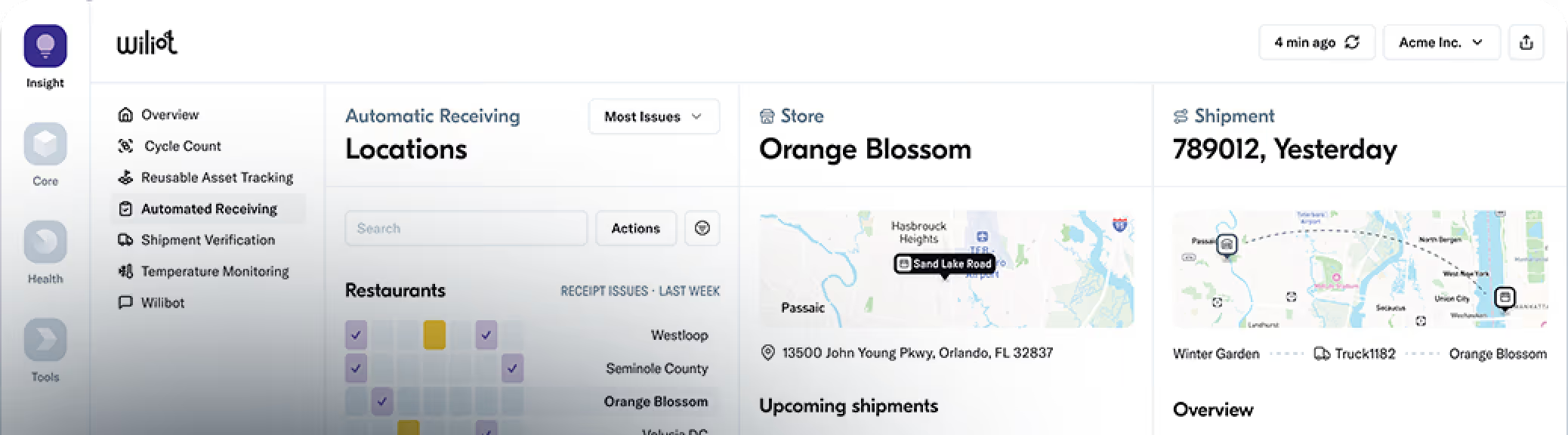
For phantom inventory, that changes the timeline. Instead of discovering a gap at the next count, you see it when it opens. A short receipt shows up at the dock rather than at the pick face, which is the job Automated Receiving is built for. An item that leaves its expected area without a matching transaction becomes visible righ taway. And because the data is continuous, you can trace where the record and reality split, not just correct the number.
Inventory Intelligence applies this acrossdefined areas like backrooms, coolers, and storage zones, so inventory updates automatically as products move. It's built to deliver 99%+ inventory accuracy. One retail DC using it eliminated annual physical counts and recovered more than $3.5M a year through labor and inventory optimization.
From Accurate Records to AI-Ready Operations
Fixing phantom inventory used tobe a housekeeping problem. Now it's a foundation problem.
Every AI initiative in your supply chain, from forecasting to replenishment to agents that act on their own, inherits whatever is wrong with the inventory record. Physical AI gives those systems ground truth to work from: continuous, item-level inventory visibility into what's actually on the shelf, not what someone last told the system.
The record and the shelf should agree. With the right sensing layer underneath your systems, they can stay that way.
Think phantom inventory is costing you more than it should? Get in touch with our team to see how continuous, item-level visibility keeps your inventory records honest.