Nobody sets out to lose a pallet. It just leaves the DC on a trailer, gets unloaded at a store, sits behind the stockroom door for three weeks, and drops off everyone's radar. Multiply that by thousands of pallets, totes, crates, and roll cages, and you get one of the most expensive problems in the supply chain that almost never shows up on a single report.
Reusable asset tracking is the practice of knowing whereyour reusable transport items (RTIs) are, how long they've been there, and whether they're coming back, across every site and handoff in the loop. Good RTI tracking replaces the end-of-quarter argument about where the assets went with a live record of where they are.
Why Reusable Assets Go Missing
Reusable assets are designed to circulate. That's the whole point. A tote moves from a DC to a store, a crate goes from a supplier to a plant, a roll cage rides a trailer out and is supposed to ride one back. Each loop crosses buildings, carriers, and sometimes companies.
Every one of those handoffs is a chance for the asset to fall out of view. And once it's out of view, nobody owns it.
The losses are bigger than most teams assume. Organizations typically lose 10–15% of their reusable assets every year to shrink, misplacement, and poor visibility. In automotive, where returnable packaging is central to just-in-time production, research cited by SupplyChainBrain puts annual losses of reusable packaging at 16% to 18%.
Here's the part that's easy to miss: a lot of "lost" assets aren't really gone. They're stuck. They're sitting in a partner's yard, stacked in a store backroom, or parked in a trailer nobody has unloaded. Loss is often just delay that nobody noticed in time.
The Hidden Cost: Buying What You Already Own
When assets disappear, operations don't stop. They compensate.
The most common response is to buy more. If a network regularly comes up short on pallets during peak, the fix is a bigger pool. If roll carts don't come back from stores fast enough, someone places an emergency order. Over time, teams end up over-buying their fleets by 30–40% just to make sure there's enough on hand.
That buffer feels safe, but it hides the real problem. A larger pool covers for slow returns and stuck assets instead of fixing them. It also ties up capital and warehouse space in equipment that's mostly sitting somewhere else.
There's a regulatory angle building, too. The EU's Packagingand Packaging Waste Regulation entered into force in February 2025 and generally applies from August 2026, with goals that include promoting reuse and refilling. As reuse becomes something companies need to show rather than simply claim, knowing how your returnable containers actually move is starting to matter beyond the operations budget.
Where Scan-Based RTI Tracking Falls Short
Most returnable container management programs today run on some mix of spreadsheets, barcode scans, and RFID reads at fixed points like dock doors.
Those tools are useful. A scan at shipping proves an asset left. An RFID gate read proves it passed through a doorway. Your WMS and ERP record those events and keep the business running.
What they can't do is see what happens between those moments. A scan-based system knows a pallet left the DC on Tuesday. It doesn't know the pallet has been sitting in a store backroom ever since. It can't tell you how long an asset has dwelled at a location, because it only captures presence at the instant of a read. And if nobody scans the asset on the way back, the record simply stops.
That's why so many RTI tracking efforts stall. The data depends on people remembering to scan at busy moments, often at partner sites you don't control. When adoption slips, the record goes stale, and teams go back to counting by hand.
Asset tracking solutions that put batteries on every container solve the visibility problem but create a new one: cost and maintenance at scale. That trade-off works for a few high-value assets. It rarely works for a pool of tens of thousands of totes.
What Continuous Reusable Asset Tracking Looks Like
The fix isn't more scanning. It's removing the need to scan at all.
That's the idea behind Wiliot's Reusable Asset Tracking solution. Battery-free IoT Pixels are applied once to pallets, totes, crates, and roll cages. They harvest energy from the radio waves already around them and report location continuously, typically multiple times a minute, without anyone pointing a scanner at them and without expensive RFID gates.
Because the sensing is continuous, the data changes character. Instead of a few scan events per trip, you get a running record of where each asset is and how long it's been there. That makes three things possible that scan-based programs struggle with.
Finding stuck assets early. When a tote has been sitting at a store well past its normal turn, that's visible while it can still be recovered, not months later during a reconciliation.
Right-sizing the fleet. When you can see utilization across DCs, stores, trailers, and returns, you can size the pool to what the network actually needs instead of padding it for uncertainty.
Rebalancing the network. If one site is hoarding assets while another runs short, you see the imbalance and move equipment before it turns into a delivery delay.
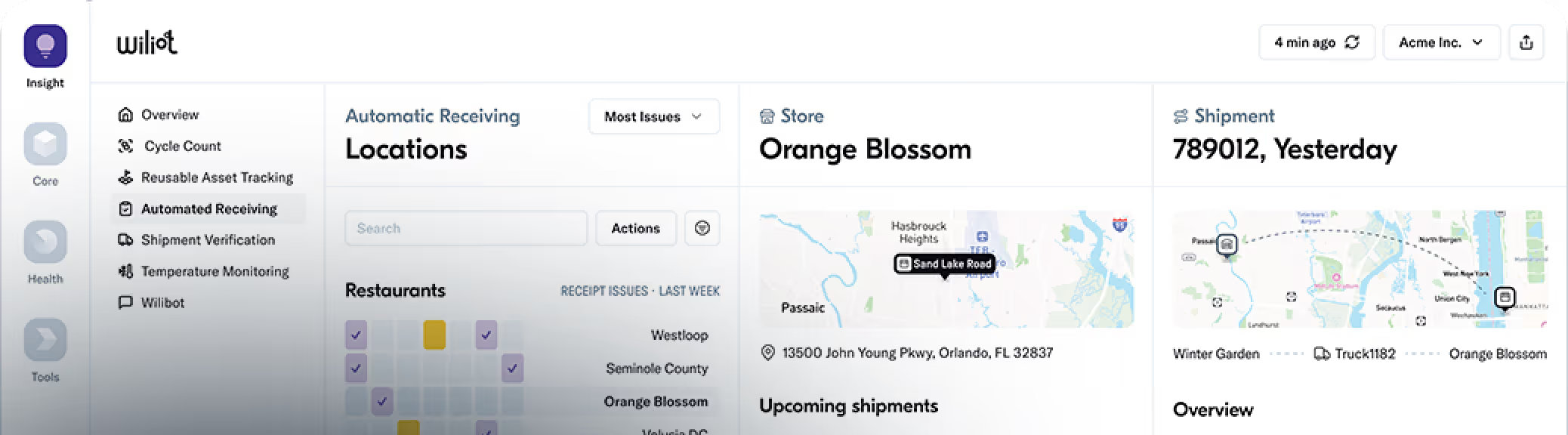
The Wiliot Physical AI Platform turns that raw signal into decisions, flagging assets that have stopped moving and surfacing where intervention will pay off. It also ingests data from the RFID and barcode systems you already run, so existing investments become inputs rather than something to rip out. Your WMS and ERP stay the system of record. Wiliot fills in the gaps between the moments they capture.
The results show up quickly. A national postal operator using Wiliot cut asset loss by 50%, saving more than $8.75M a year. A retail distribution network reduced its fleet size by 30–40%, avoiding millions in capital spending.
How to Get an RTI Tracking Program Started
You don't need to tag every asset in the network on day one. The programs that work tend to start small and specific.
- Pick one loop that hurts. A single DC-to-store route with chronic roll cart shortages is a better starting point than the entire network.
- Define what "stuck" means. Agree on how long an asset should normally sit at each location type, so dwell beyond that becomes an exception someone acts on.
- Decide who owns the exception. Visibility only pays off when a specific team is responsible for recovering or rebalancing assets.
- Measure in money, not dashboards. Track emergency purchases avoided, fleet size, and loss rate before and after.
Once one loop is working, the same approach extends to more sites, more partners, and more asset types.
From Asset Visibility to Autonomous Operations
Reusable asset tracking is a good example of where supply chains are heading more broadly. The goal isn't another dashboard showing where pallets were last scanned. It's an operation that notices a stuck asset, knows why it matters, and triggers the right response without someone hunting for it.
That kind of operational intelligence depends on one thing above all: continuous, trustworthy data about the physical world. When every pallet, tote, and container can report for itself, RTI loss prevention stops being a quarterly cleanup project and becomes part of how the network runs every day.
Ready to find out where your reusable assets really are? Get in touch with our team to talk about continuous reusable asset tracking.